Residency 6 - Spring 2024
Susanne Bürner, Annette Kelm, Alexandra Leykauf & Ines Kaag
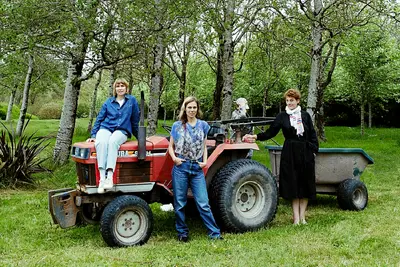
Photo: Jason Lee
Alexandra Leykauf lives and works in Berlin. In recent years, she has presented numerous solo exhibitions, including ‘Prospect’, Camera Austria, Graz (2024); ‘What We Do in the Shadow’ (with Dominik Styk), GAK–Gesellschaft für Aktuelle Kunst, Bremen (2022); ‘Animus’, Kunstverein Springhornhof, Neuenkirchen (2022); ‘Window Shopping’ (with Eva Berendes), Kunstverein Siegen (2021), and ‘Both Sides Now’, Villa du Parc/Centre d’art contemporain, Annemasse (2020). She has also participated in group exhibitions, including ‘Artocène’, Musée Alpin, Chamonix Mont-Blanc (2023); La Friche la Belle de Mai, Marseille (2022); Galerie Bo Bjerggaard, Copenhagen (2019); and Künstlerhaus Dortmund (2019). Her works are held in the collections of Piers Arts Centre, Orkney (UK); Centre Pompidou (FR); Musée d’Art Moderne de la Ville de Paris (FR); and the Royal Dutch KPN Collection (NL). Alexandra Leykauf studied at the Academy of Fine Arts Nuremberg (1996–2002), the Gerrit Rietveld Academie (1998–2002), and the Rijksakademie van Beeldende Kunsten (2003–2004) in Amsterdam.
Ines Kaag has worked since 1997 as part of the duo BLESS (co-founded with Desiree Heiss), developing numerous transdisciplinary projects. BLESS describes its practice as ‘situational design’, combining fashion and art, design and architecture, business and social practice, and aiming to create a balance between intellectual and physical engagement. Based on the ambition to produce objects for everyday use, BLESS defines its practice and products as a way of life — grounded in the firm belief that the future can be actively and independently shaped.
Annette Kelm was born in 1975 in Stuttgart, Germany. She lives and works in Berlin. Annette Kelm studied at Hochschule für bildende Künste, Hamburg. She received numerous awards and prizes, among them Camera Austria Prize (2015); Preis der Nationalgalerie, Audience Award (2009); and Art Cologne Prize for Young Artists( 2005). Annette Kelm’s photographic œuvre offers a unique outlook onto the socio-cultural history of the material world. The artist uses a vast array of motifs as vocabulary to address specific moments in this history, whether it is the commodification of design objects, various forms of political critiqueor value systems such as money and finance. Kelm’s exhibitions gather images of floral sculptures, landscapes, portraiture, photographed buildings, and ephemeral objects of all scales. Meticulously picked, the artist’s subjects enter in collision and contrasts where the objective converges with the subjective, the every-day encounters the historical, and the impartial becomes political. Her practice draws from conventional studio photography techniques: employing a large-format camera and depicting her subjects in front of a backdrop. The arrangements that the artist sets up at her studio are often playful, retain an experimental character or are seemingly captured glimpses of time. Kelm’s distinctive approach to the photographic medium made her a prominent figure of contemporary photography in Germany and worldwide.
Susanne Bürner’s artistic practice engages with the body and the surrounding architectural or natural space, most often in the form of the photographic image. Her works play with truth and illusion, presence and absence, and with references to the off-frame, the space beyond the image. Film and photography are particularly suited to this exploration, as they are still regarded as forms of evidence. In her text-based posters, Bürner moves between intimate emotions and public space. Her works shift between different perspectives and raise questions about the perceptual and social systems in which we operate. She expands the frame of our perception away from hierarchical modes of seeing toward marginalised emotions, beings and objects that hold alternative possibilities. Her images convey the fragility of human identity and our complex search for orientation.